
Launching October 2026
The most intelligent way
to run the USA
Real-Time Law is a new kind of law that watches the world and responds honestly to the facts — automatically, transparently, and without further debate.
The Idea
The way we make laws has not kept pace with the world those laws are supposed to govern. We argue, we vote, we pass something — and then we lock it in, often for generations, regardless of whether it's working. When the facts change, the law doesn't.
Real-Time Law answers that problem directly. Instead of creating a static rule and fighting over it, a Real-Time Law holds all the major arguments side by side — one for each significant viewpoint in the debate. Each argument states its predictions clearly: if this public data shows this, then this rule applies. Every day, the law checks the facts. The argument best supported by the evidence, over a meaningful period of time, becomes effective law — automatically and transparently.
The most intelligent, the most peaceful, the most transparent, and the most representative way to place rules upon ourselves.
Real-Time Law is built on publicly verifiable government data — safety statistics, health records, economic indicators, environmental measurements. No one wins by spin or by pressure. The data does the talking.
Real-Time Law is designed for arguments that can be measured — claims that publicly recorded facts can, over time, prove or disprove. Not every disagreement lends itself to this kind of resolution. But many do, and often far more than people expect once they start looking.
How It Works
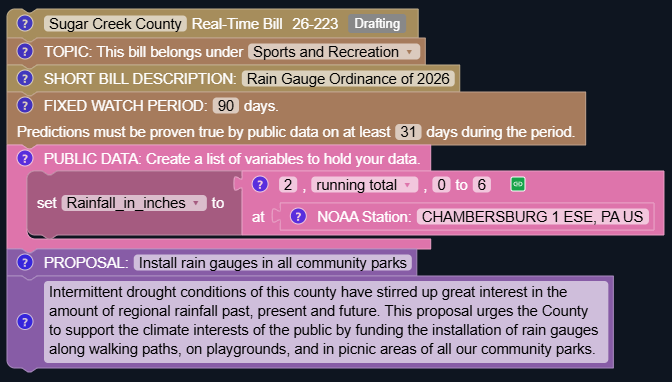
A Real-Time Law is built with the Real-Time Law Billboard — a visual, block-based editor that guides citizens, advocates, and lawmakers through the process of constructing a law from the ground up. Each block represents a concept: a jurisdiction, a topic, a prediction, a rule. Snap them together and the law assembles itself in plain English.
Once drafted, the law moves through a standard legislative process — votes, executive signing or veto, and override — all tracked in the open. Once enacted, the law is handed off to the Real-Time Law Processor, which checks the relevant public data every day. If a proposal's predictions have been supported during the watch period, the public is notified and the rule moves toward becoming effective law. This happens automatically, exactly according to the requirements that were built into the bill.
What's Coming
The Invitation
Real-Time Law is designed for everyone — students, teachers, lawmakers, activists, and ordinary citizens. Any group willing to try its hand at civil discourse, data-driven lawmaking, scientifically governed policy — will become the most interesting government on earth.